








A printer failure at 8:15 a.m. is rarely just a printer failure. It can delay invoices, interrupt customer service, frustrate employees, and pull an owner or office manager away from work that actually moves the business forward. That is why the outsourced IT vs internal technician decision is not simply a staffing question. It is a decision about coverage, accountability, cost, and how well technology supports daily operations.
For a small or midsize business, the right answer depends on the complexity of your environment, the pace of growth, and the type of help your team needs. Some companies benefit from having a technician on-site every day. Many others get stronger coverage and more flexibility from an outsourced IT partner. The key is to compare the full operating model, not just a monthly invoice or salary.
Outsourced IT vs Internal Technician: The Core Difference
An internal technician is an employee whose time and attention are dedicated to your organization. They may handle help desk requests, device setup, user access, network troubleshooting, vendor coordination, and basic security tasks. Depending on their experience, they may also manage servers, cloud platforms, business applications, and strategic technology planning.
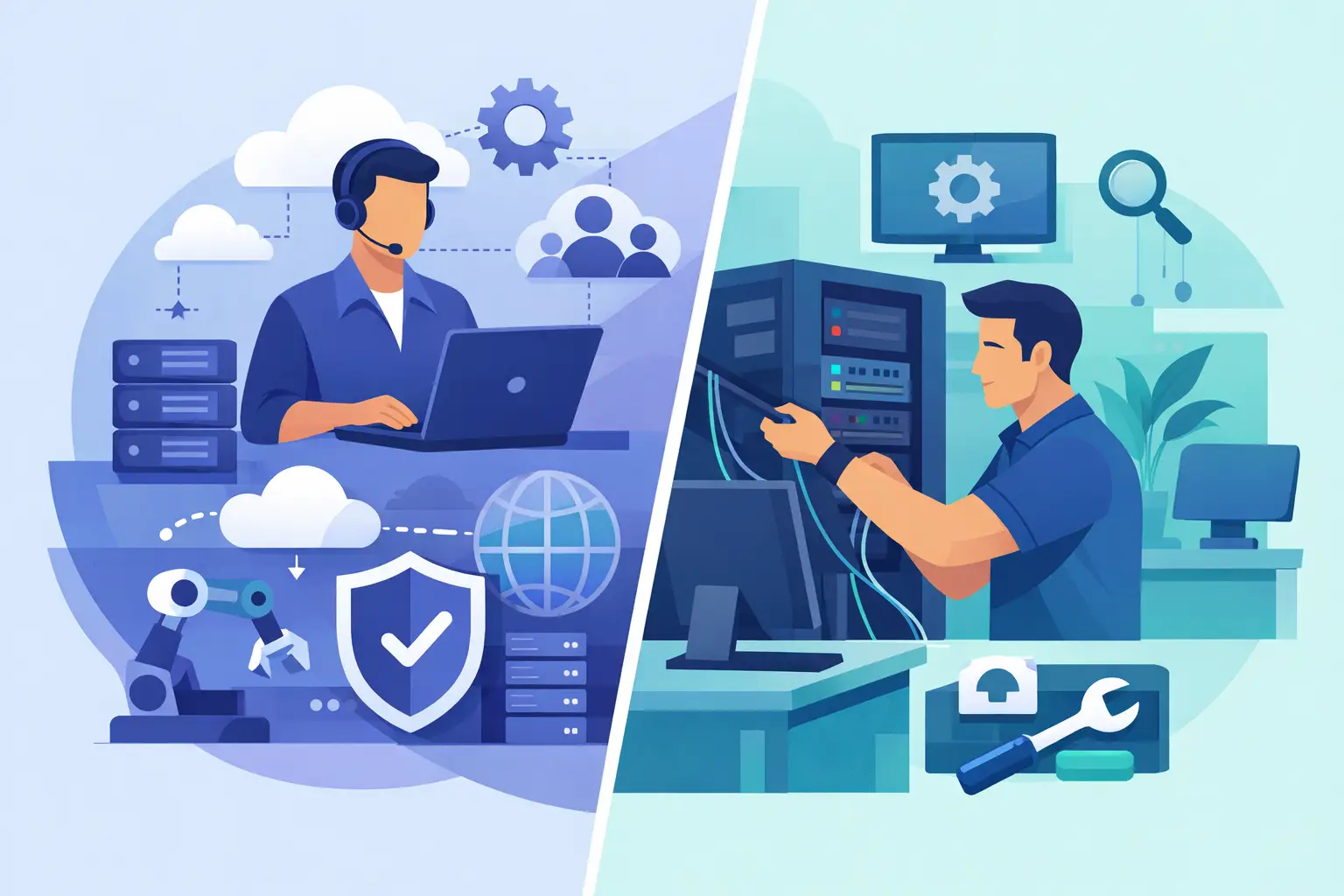
Outsourced IT gives your business access to an external support team under a service agreement. That team typically provides remote troubleshooting, maintenance, monitoring, project support, and guidance when larger technology decisions arise. The exact scope varies, so businesses should be clear about what is included, how quickly issues are handled, and where project work begins.
The practical difference is breadth. One internal technician brings one person’s availability and skill set. A good outsourced provider brings a team with coverage across common support needs, infrastructure, websites, workflows, and specialized projects. That does not automatically make outsourcing better. It does mean the comparison should include more than who can reset passwords or fix a laptop.
Cost Is More Than Salary
Hiring internally can look straightforward: calculate salary, add benefits, and compare the number to an outsourced monthly fee. The real cost is broader.
An internal technician may need benefits, payroll taxes, training, software tools, hardware, backup coverage during time off, and occasional outside specialists when work exceeds their expertise. Recruiting also takes time. If the employee leaves, your business may face a gap in support while knowledge of your systems walks out the door.
Outsourced IT is generally easier to budget because service costs are established in advance. It can also reduce surprise spending tied to emergency troubleshooting or finding a specialist at the last minute. Still, a low monthly price is not always a good value. A provider that excludes essential support, responds slowly, or treats every meaningful issue as an extra charge can create just as much operational friction.
For many growing businesses, outsourcing makes sense because they need reliable coverage but do not yet have enough daily IT work to justify a full-time hire. Once a company has a larger employee base, several locations, highly specialized systems, or frequent on-site needs, an internal role may become more practical.
Coverage and Response Time Matter More Than Titles
Businesses often assume an internal technician will always respond faster because they are physically present. That can be true for hands-on problems, such as replacing equipment, resolving cabling issues, or supporting a conference room before an important meeting. Physical proximity has real value.
But most day-to-day issues do not require someone to be at a desk nearby. Account access, email problems, software errors, device configuration, file permissions, and many network concerns can be diagnosed and resolved remotely. In those cases, response standards, ticket visibility, and communication habits matter more than whether the person is employed internally or externally.
An internal technician can also become overloaded. When one person is handling every request, urgent interruptions often push maintenance, documentation, planning, and improvement work aside. The business gets support, but not always progress.
An outsourced team can distribute work across available people and bring in the right experience for the problem. The trade-off is that the provider needs to understand your business well enough to act quickly. If every request starts with explaining your systems, team structure, and priorities, the relationship will feel slow no matter how capable the provider is.
Specialized Needs Change the Equation
Technology support is no longer limited to computers and Wi-Fi. A business may need a better website, a customer portal, an internal form that removes manual work, stronger branding, a simple app workflow, or help connecting systems that employees currently manage with spreadsheets and email.
A capable internal technician may be excellent at support but not necessarily experienced in web development, UI/UX design, application development, conversion-focused content, or digital process improvement. Asking one person to cover every technical and digital need can create bottlenecks or force the business to add separate vendors anyway.
This is where a broader outsourced partner can be valuable. Set IT Solutions, for example, is built to support everyday technology while also helping businesses improve the websites, tools, and workflows that affect customer experience and internal efficiency. The benefit is not just fewer vendors. It is having one team that can see how an unreliable device, outdated site, manual process, or disconnected system affects the same business operation.
That said, a highly technical internal environment may still require a dedicated employee. Companies with industry-specific software, strict compliance demands, complex servers, or constant on-site operations often benefit from someone who knows the environment in exceptional detail.
When an Internal Technician Is the Better Fit
An internal technician can be the right investment when technology is central to the company’s daily output and requires regular physical attention. Manufacturing floors, healthcare settings, large offices, and businesses with complex equipment may need an employee who can respond in person without delay.
Internal support also works well when a business has enough volume to keep a full-time professional focused on meaningful work. If requests, onboarding, equipment management, and operational projects consistently fill the role, hiring can create stronger continuity.
The risk is hiring too early or hiring for too narrow a role. A company may bring someone on to solve immediate help desk problems, then discover it still needs outside help for security, website projects, cloud migrations, design work, and specialized application needs. That can leave the internal employee stretched thin and the business managing a growing list of vendors.
When Outsourced IT Is the Better Fit
Outsourced support is often a strong fit for businesses that need dependable help but cannot justify a full internal department. It provides a practical path for organizations that want support coverage, clear escalation, and access to different capabilities without carrying the cost of several full-time hires.
It can be especially useful when your business is growing, opening a new location, replacing outdated systems, improving a website, or trying to clean up inefficient processes. Rather than hiring based on one current pain point, you can work with a team that supports routine needs while helping plan the next improvement.
Look for these signs that outsourcing may fit your business:
- Your office manager or owner is still the unofficial technology support person.
- Technology issues interrupt staff, but there is not enough work for a full-time IT hire.
- You rely on separate vendors for computers, websites, software, and design.
- Your business needs faster support and better documentation, not just occasional emergency fixes.
- You want help improving systems and workflows, not simply keeping old tools running.
A Hybrid Model Can Be the Most Practical Choice
The decision is not always either-or. Many midsize organizations benefit from an internal operations or technology coordinator supported by an outsourced IT team. The internal person handles employee communication, equipment logistics, and business context. The outsourced team provides troubleshooting depth, project capacity, technical guidance, and backup coverage.
This approach can work particularly well when a trusted employee understands the day-to-day operation but does not need to become a network expert, web developer, or software administrator. It keeps accountability close to the business while reducing the pressure to hire multiple specialists.
Before choosing a model, document the work your business actually needs for 60 to 90 days. Track recurring support requests, on-site issues, new employee setup, vendor coordination, website needs, system frustrations, and projects that have been delayed. That record will show whether you need a full-time person, a flexible support team, or a combination of both.
The best choice is the one that gives your people dependable help, keeps important work moving, and creates room for technology to improve the business rather than consume its attention.