









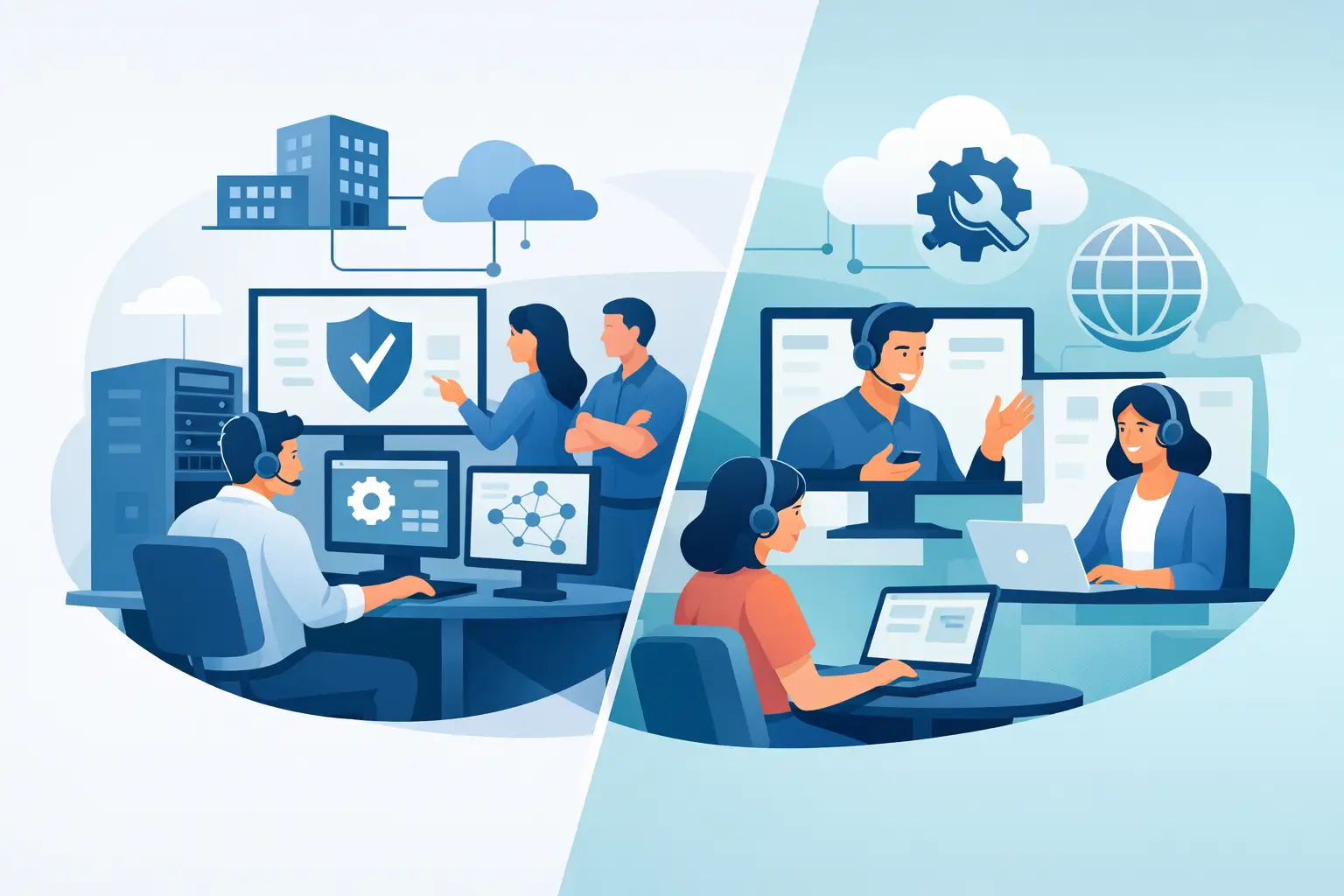
When a staff member cannot access a shared drive, the office printer stops working, and your website form stops sending leads on the same day, the question of in house IT vs outsourced support stops being theoretical. It becomes an operations issue. For small and midsize businesses, the right choice is rarely about prestige or control. It is about keeping work moving, customers served, and technology from turning into a daily distraction.
The challenge is that both models can work. A strong internal hire can be valuable. A reliable outside partner can be just as valuable, and often more practical. The better option depends on your size, your pace of growth, the complexity of your systems, and how much technology support you really need across the business.
How in house IT vs outsourced support affects daily operations
The biggest difference between in house IT vs outsourced support is not just where the work gets done. It is how coverage, accountability, and business priorities are handled.
With in-house IT, you are hiring an employee or team to manage your systems internally. That usually means direct oversight, close familiarity with your staff, and immediate access to someone who knows the environment. For businesses with complex networks, compliance requirements, or a large number of users, that can be a good fit.
With outsourced support, you work with an external provider that handles technical issues, maintenance, troubleshooting, and often broader digital needs. Depending on the provider, that can include remote support, device management, cybersecurity basics, website help, workflow improvements, and coordination across the tools your team uses every day.
For many SMBs, the real issue is scope. Internal IT often starts with one role, but one person cannot realistically cover hardware, user support, cybersecurity, vendor coordination, cloud systems, website issues, and process improvement at a high level all at once. Outsourced support can spread that workload across a team.
Cost is not just salary
It is easy to assume in-house support is more expensive because of salary, benefits, taxes, training, and equipment. In many cases, that is true. But the more useful comparison is total business cost.
An internal IT hire may cost more than the paycheck suggests. There is recruiting time, onboarding, management overhead, and the risk of gaps if that person leaves. If your business depends heavily on one internal employee for technical knowledge, turnover can create expensive disruption.
Outsourced support usually offers more predictable monthly costs. That matters for budgeting, especially for companies that do not want a full-time payroll commitment but still need consistent help. You are paying for access to a team and a service model rather than hoping one person can handle every issue.
That said, outsourced support is not automatically cheaper in every scenario. If your company has enough volume to keep a full internal IT team busy all week, and your needs are highly specialized, in-house staffing may make financial sense. The point is to compare cost against actual coverage, not just against salary.
Response time depends on structure, not assumptions
Some business owners assume an in-house person will always respond faster. Sometimes that is true. If someone is down the hall and available, they can often solve simple problems quickly.
But availability is not the same as capacity. One internal IT employee can only handle one issue at a time. If they are setting up a workstation, dealing with a server problem, or out sick, response time slips fast.
A good outsourced provider should offer structured support, ticket prioritization, remote troubleshooting, and broader team coverage. That often means faster handling for day-to-day issues because there is more than one person available. For smaller companies, that team model can deliver more dependable responsiveness than relying on a single hire.
This is especially true if your needs go beyond device support. If email is down, a vendor integration is failing, and your website needs an update before a campaign goes live, a broader support partner can often address those issues under one relationship instead of pushing you to separate specialists.
Coverage matters more than titles
A lot of businesses hire in-house because they want ownership. That makes sense. The problem is that one title does not equal full coverage.
A general IT manager may be strong with endpoints and networking but less comfortable with website troubleshooting, design changes, software workflow problems, or customer-facing tools. A developer may build internal tools well but not want to handle printer issues and password resets. Even a talented internal team can end up fragmented if responsibilities are not clear.
This is where outsourced support can be a better operational fit. The right partner does not just fix technical issues. They help close the gaps between support, websites, apps, design, and business workflows. For many growing companies, those gaps are where time and revenue are lost.
If your business is juggling separate vendors for IT, web updates, branding tweaks, and internal process fixes, you are already seeing the downside of fragmented coverage. Problems get bounced around. No one owns the full result. Deadlines slip because each vendor is only responsible for part of the issue.
When in-house IT makes sense
There are clear situations where building internally is the right call. If your company has a large employee base, multiple locations, heavy compliance obligations, or complex on-site infrastructure, dedicated internal staffing can be a strong investment.
It also makes sense if technology is central to your business in a very specialized way. For example, if you rely on custom systems that need daily oversight or your operations require constant on-site technical management, in-house support can provide tighter control.
Some business owners also prefer internal teams because they want someone fully embedded in the company culture. That can improve communication and long-term planning, especially in larger organizations where IT leadership is part of broader operational strategy.
Still, even in these cases, internal teams often need outside help for overflow, project work, security support, website development, app work, or specialized troubleshooting.
When outsourced support makes more sense
For many Utah small and midsize businesses, outsourced support is the more practical choice because the need is broad but not deep enough to justify multiple full-time hires. You need help with user issues, systems upkeep, remote troubleshooting, software questions, website performance, and occasional workflow improvements. You do not necessarily need a full internal department.
Outsourced support is especially useful when your business wants one point of accountability. That means fewer handoffs, less vendor management, and a better chance that the person solving the issue understands how it affects the rest of the business.
This model also works well for growing companies. You can get structured support now without hiring too early, then adjust as your needs become clearer. Instead of guessing what kind of internal IT role to build, you can cover current needs while keeping room to scale.
A provider like Set IT Solutions can be valuable in that scenario because support does not stop at basic troubleshooting. Businesses often need website help, internal tools, design support, and practical workflow improvements at the same time they need reliable day-to-day IT assistance.
The hybrid model is often the smartest answer
Many companies treat this as an either-or decision when it is really a staffing design question. Hybrid support often makes the most sense.
In a hybrid setup, an internal operations lead, office manager, or IT coordinator handles business context and priorities, while an outsourced team provides technical depth and coverage. In larger companies, one internal IT person may manage strategy and vendor oversight while an outside partner covers help desk work, project execution, website updates, and specialized support.
This approach reduces single-person dependency and gives the business more flexibility. It can also improve service quality because each side is focused on what they handle best.
How to decide without overthinking it
Start with your actual workload. Look at the last six months of issues. How many were user support requests? How many involved websites, software vendors, device setup, cloud systems, or workflow bottlenecks? How often did problems need on-site help versus remote help?
Then look at risk. If one person left tomorrow, how exposed would your business be? If your website broke, customer portal failed, or staff lost access to a core system, who would own the fix from start to finish?
Finally, look at growth. If your business is adding staff, locations, software, or digital services, choose a model that can keep up without forcing you to rebuild your support structure every year.
The best choice in house IT vs outsourced support is the one that gives your business reliable coverage, clear accountability, and enough flexibility to keep moving. Technology support should make operations easier, not add another management problem. If your current setup leaves too many gaps, that is usually your answer.
The most useful support model is not the one that sounds bigger or more impressive. It is the one that helps your team stay productive, keeps customer-facing systems working, and gives you fewer loose ends to chase tomorrow.