









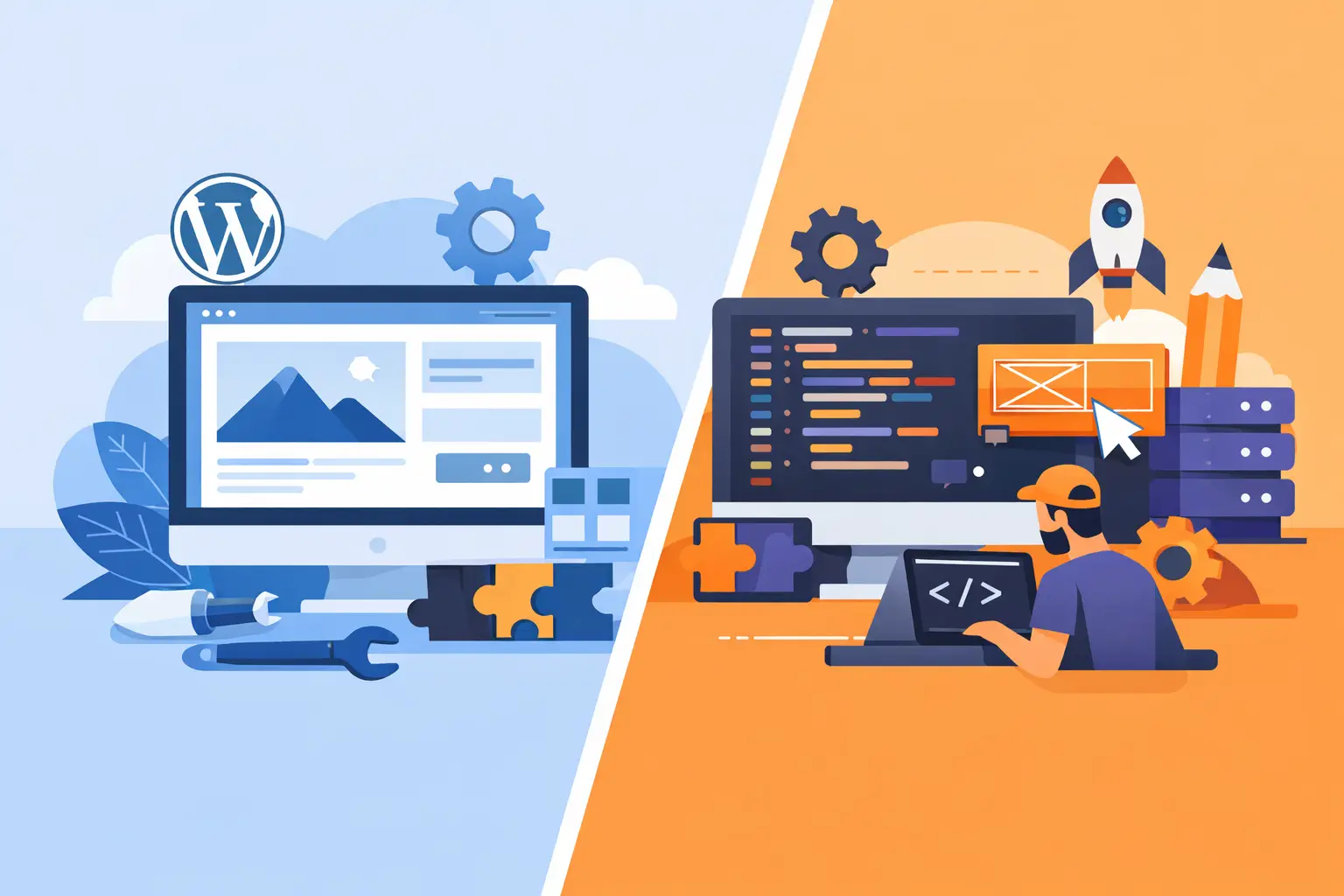
A business website usually starts with a simple question and turns into a bigger operational decision: should you build on WordPress, or invest in something custom from the ground up? When business owners compare WordPress vs custom website development, they are not just choosing a platform. They are choosing how their site will be managed, updated, supported, and expanded over time.
For small and midsize businesses, that choice affects more than design. It impacts speed to launch, budget, lead generation, maintenance workload, and how easily the site can support future business needs. The right answer depends on what the website is supposed to do for the business now and what it may need to handle later.
WordPress vs custom website development: the real difference
At a basic level, WordPress is a content management system that gives businesses a faster way to launch and manage websites. It is widely used, flexible, and supported by a large ecosystem of themes, plugins, and developers. For many companies, that means lower upfront costs and quicker implementation.
Custom website development is different. Instead of building around an existing platform, the website is designed and developed specifically for the business. That can include custom code, custom functionality, and a tailored admin experience. It usually takes longer and costs more, but it offers more control over how the site works behind the scenes.
This is where some businesses get stuck. They hear that WordPress is affordable and easy, while custom development sounds more advanced. That framing is too simplistic. WordPress can be the right long-term solution for many organizations, and custom development can be unnecessary if the business does not need specialized features. At the same time, there are situations where WordPress becomes limiting, especially when workflows, integrations, or user experiences need to do something very specific.
When WordPress makes the most sense
WordPress is often the practical choice for businesses that need a professional website without overcomplicating the project. If your site is primarily focused on marketing, lead generation, service pages, blog content, and standard contact or quote forms, WordPress is usually a strong fit.
It gives businesses a manageable system for updating content internally. Staff can edit text, post news, add pages, and make routine changes without relying on a developer for every adjustment. That matters for companies that want their site to stay current but do not have a dedicated web team.
WordPress also works well when speed matters. If your current site is outdated, difficult to update, or underperforming, a WordPress build can often get you to a better result faster than a full custom project. For many small and midsize businesses, getting a clean, responsive, conversion-focused website live in a reasonable timeframe is more valuable than paying for features they may never use.
Another advantage is familiarity. Because WordPress is so widely adopted, support is easier to find. That does not mean every implementation is equal, but it does reduce the risk of ending up with a site no one can maintain.
Where WordPress can create limitations
WordPress is flexible, but flexibility often comes through plugins, third-party tools, and layered configurations. That can work well for standard needs. It can also create complexity if the site starts doing too much.
For example, if your business needs a customer portal, unusual user roles, advanced internal workflows, or highly specific integrations with outside systems, WordPress may require workarounds. Those workarounds can increase maintenance needs and make the site harder to troubleshoot later.
Performance can also become an issue when a site is overloaded with unnecessary plugins or built without a clear structure. WordPress itself is not the problem in most cases. Poor planning, low-quality development, and too many add-ons usually are. Still, if your business requires a lean system with tightly controlled functionality, a custom build may offer a cleaner path.
Security is another practical concern. Any widely used platform receives attention from attackers, and WordPress is no exception. A properly maintained WordPress site can be secure, but it needs updates, monitoring, and good development practices. Businesses that do not have a reliable support process in place can end up with preventable issues.
When custom website development is worth it
Custom website development makes sense when the website is not just a marketing tool, but a business system. If the site needs to support custom applications, user-specific dashboards, complex workflows, or unique service functionality, a custom approach can save time and frustration in the long run.
This is especially true when the website has to connect closely with internal operations. Maybe your team needs a client login area, a custom estimator, a scheduling process tied to internal systems, or a portal that handles more than standard form submissions. In those cases, building exactly what the business needs can be more efficient than forcing a general platform to behave like specialized software.
Custom development also gives more control over performance and architecture. Instead of depending on a mix of third-party tools, the site can be designed with only the features that matter. That often leads to cleaner code, fewer moving parts, and a better fit for long-term growth.
That said, custom does not automatically mean better. A custom site is only as good as the planning, development, and support behind it. If the project is not managed well, businesses can end up with something expensive, difficult to maintain, or overly dependent on a single developer or agency.
Cost is not just about the initial build
Budget is usually one of the first factors in the WordPress vs custom website development conversation, and for good reason. WordPress typically has a lower upfront cost. Businesses can launch faster and avoid paying for features they do not need.
Custom development generally requires a larger investment because the work is more specialized. Strategy, design, coding, testing, and future enhancements are all more tailored. For some businesses, that cost is justified. For others, it creates unnecessary overhead.
The more useful question is not just, “What does it cost to build?” It is, “What will it cost to operate and improve over the next few years?” A lower-cost site that becomes difficult to update, breaks when plugins change, or cannot support business growth may become expensive over time. On the other hand, a custom site that solves the wrong problem is not a smart investment either.
Business owners should think in terms of total value. That includes launch cost, maintenance, support, upgrade needs, and how well the site helps generate leads or improve operations.
Support and maintenance matter more than most businesses expect
A website is not a one-time purchase. It is an active business asset. Whether it is built on WordPress or developed from scratch, it needs updates, troubleshooting, design adjustments, and occasional improvements.
This is where many businesses run into trouble. They focus on the build and underestimate the support needed after launch. A WordPress site needs plugin updates, security checks, backups, and performance reviews. A custom site needs code maintenance, hosting oversight, bug fixes, and a team that understands the original build.
The better option is often the one your business can realistically support. If your internal team wants the ability to manage common updates easily, WordPress may be the better fit. If your site is tightly tied to custom business processes and you already need ongoing technical support, custom development may be more appropriate.
For Utah businesses that want one team handling both website work and broader technical support, the decision also affects vendor management. A website should not live in its own silo if it connects to daily operations, customer communication, or internal tools.
How to decide between WordPress and custom
The best decision starts with business requirements, not platform preferences. If the goal is a reliable marketing site that supports content updates, lead generation, and a professional online presence, WordPress is often the most efficient answer.
If the site needs to perform like a custom application, support specialized functionality, or integrate deeply with business workflows, custom development becomes easier to justify. The key is being honest about what is truly necessary. Some businesses assume they need custom because they want something unique. In reality, they may need thoughtful design and strong implementation, not a fully custom system.
It also helps to think about internal capacity. Who will maintain the site? How often will it change? Will it need to connect with other systems? Is the business trying to solve a marketing problem, an operational problem, or both? Those questions usually point toward the right solution faster than feature wish lists do.
At Set IT Solutions, this is often where the conversation becomes practical. The right website choice is not the one with the most features. It is the one that fits the business, works reliably, and can be supported without creating more complexity than it solves.
A good website should make your business easier to run and easier to trust. If your next web project does that clearly, you are already on the right track.