








A printer failure at 8:15, email issues by 9:00, and a website form that stops sending leads before lunch – for many small businesses, that is not an unusual day. The problem is not just technology breaking. It is the cost of losing time, missing revenue, and asking already-busy staff to solve problems they were never hired to handle. That is where an outsourced IT department for small business starts to make sense.
For a small or midsize company, the real question is not whether technology matters. It already runs your phones, files, website, scheduling, communication, and customer experience. The better question is how you want that technology managed. Hiring a full internal team is often too expensive. Managing separate vendors for support, web work, software fixes, and design creates its own problems. An outsourced model gives you a more practical middle ground.
What an outsourced IT department for small business actually means
Some business owners hear the term and think it means basic help desk support. In practice, it should mean much more than password resets and device setup. A good outsourced IT department helps keep daily operations moving while also improving the systems your team depends on.
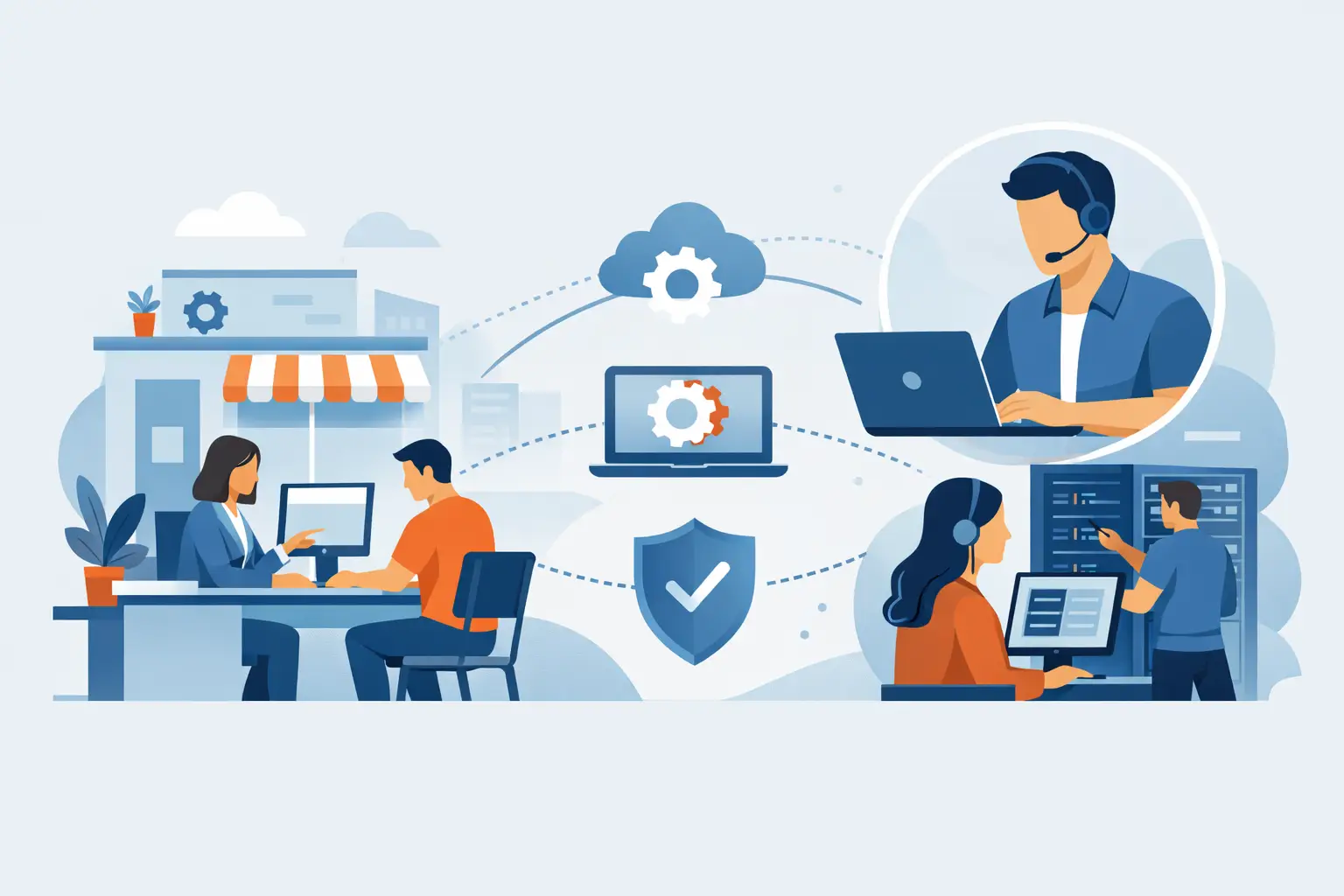
That includes routine support like troubleshooting workstations, email, networks, and user access. It can also include website management, internal workflow improvements, remote support, and guidance on the tools your business is paying for each month. If your website generates leads, your customer portal affects service, or your team relies on shared systems to stay productive, those pieces should not sit in separate silos.
This is where the outsourced approach becomes more valuable than a narrow support contract. You are not just paying someone to react when things fail. You are creating a single point of accountability for the technology your business uses every day.
Why small businesses choose to outsource instead of hire in-house
For most small companies, building an internal IT department is hard to justify. One hire may help with support tickets, but that person probably will not also handle website updates, workflow improvements, vendor coordination, security basics, and digital execution. To cover all of that in-house, you usually need more than one person, and the cost rises quickly.
Outsourcing changes the equation. Instead of depending on one employee with a limited range, you gain access to a broader team. That matters when your needs cross over from desktop support to website issues to operational tools. It also reduces the risk that comes with relying on a single internal person who may be unavailable, overloaded, or focused on only one area.
There is also a management benefit. Small businesses often end up juggling a local IT freelancer, a web developer, a phone vendor, and maybe an app consultant. When something goes wrong, each vendor points somewhere else. Outsourcing to one coordinated team reduces that friction and gives your business a clearer path to resolution.
The business value is bigger than tech support
The strongest case for outsourcing is not just cost savings. It is business continuity.
When systems work, your staff can stay focused on customers, scheduling, sales, and delivery. When they do not, your operation slows down in ways that rarely show up on an IT invoice. A broken shared drive can delay estimates. Website issues can quietly reduce lead volume. Poor user setup can create security problems and wasted time. These are operational issues, not just technical ones.
A capable outsourced IT department looks at technology as part of the business engine. That means keeping devices functional, but it also means paying attention to the website that brings in business, the tools your team struggles with, and the repeat problems that keep costing time every week.
For a growing company, this matters even more. Growth usually adds complexity before it adds structure. More employees, more software, more customer communication, and more moving parts can expose weak systems quickly. Outsourced support helps stabilize that growth without forcing you to build a large internal department too early.
What to expect from the right provider
Not every provider is built the same. Some focus only on infrastructure. Others are project-based and disappear after setup. Small businesses usually need a partner that can support day-to-day operations while also helping improve customer-facing and internal systems.
That starts with responsiveness. If employees cannot access files or customers cannot submit a form, waiting days for a reply is not acceptable. Clear communication matters just as much as technical skill. Business owners and office managers should not need to translate technical jargon to understand what is happening or what action is needed.
A good partner should also be practical. They should recommend tools and fixes that match your size, budget, and workflow instead of pushing enterprise-level complexity. The right answer for a 15-person company is often different from the right answer for a 200-person operation.
It also helps when the provider can support both operational technology and digital execution. If your IT team can fix user issues but cannot help when your website is outdated, your systems are still fragmented. For many small businesses, the better model is one team that can handle support, website updates, internal tools, and related design or workflow needs together.
Signs your business has outgrown the current setup
Many companies wait too long to make this change because the existing arrangement still kind of works. The issue is that partial support often creates ongoing drag.
If employees regularly bring tech problems to whoever seems most available, you do not have a real support structure. If your website is outdated because no one owns it, that is not just a marketing issue. If vendors blame each other when systems fail, accountability is missing. If the owner or office manager is still coordinating logins, devices, updates, and website fixes, the business is carrying work that should already be off their plate.
Another common sign is inconsistency. Things get fixed, but only after follow-up, delays, or confusion. Small businesses can absorb that for a while, but the cost builds over time. Slower work, missed leads, employee frustration, and recurring problems usually point to the same issue: there is no reliable team managing technology as an ongoing business function.
How to evaluate an outsourced IT department for small business
The best evaluation is not based on technical buzzwords. It is based on how well the provider fits your operation.
Start with scope. Ask what they actually support on a recurring basis. Can they handle users, devices, remote troubleshooting, and system issues? Can they also support your website, internal tools, or operational workflows if needed? The more your business depends on connected systems, the more valuable broader coverage becomes.
Next, look at communication. You want a team that explains issues clearly, responds consistently, and works well with nontechnical staff. That sounds basic, but it is one of the main differences between a vendor you tolerate and a partner you rely on.
Then consider accountability. If a website form breaks, a login fails, or a process is slowing staff down, will they take ownership and help solve it? Or will they hand you another vendor to call? Small businesses benefit most from a provider that treats technology as one connected environment rather than a set of isolated tasks.
Finally, think about fit over scale. The biggest provider is not always the best provider. A practical, responsive team that understands small business operations often delivers better results than a larger firm built around enterprise processes.
For Utah businesses, this is often why a service partner like Set IT Solutions stands out. The value is not just support tickets getting closed. It is having one dependable team that can keep systems running, improve digital tools, and reduce the daily friction that pulls staff away from real work.
A smarter way to support growth
Small businesses do not need more complexity. They need technology support that keeps operations steady, solves problems quickly, and helps digital assets perform the way they should. An outsourced IT department can do that well when it is built around responsiveness, practical execution, and business needs rather than technical theory alone.
The right setup should make your day quieter. Fewer handoffs, fewer recurring issues, and fewer moments where your staff is stuck waiting on a fix. That kind of support does more than maintain systems. It gives your business room to operate with more confidence.