









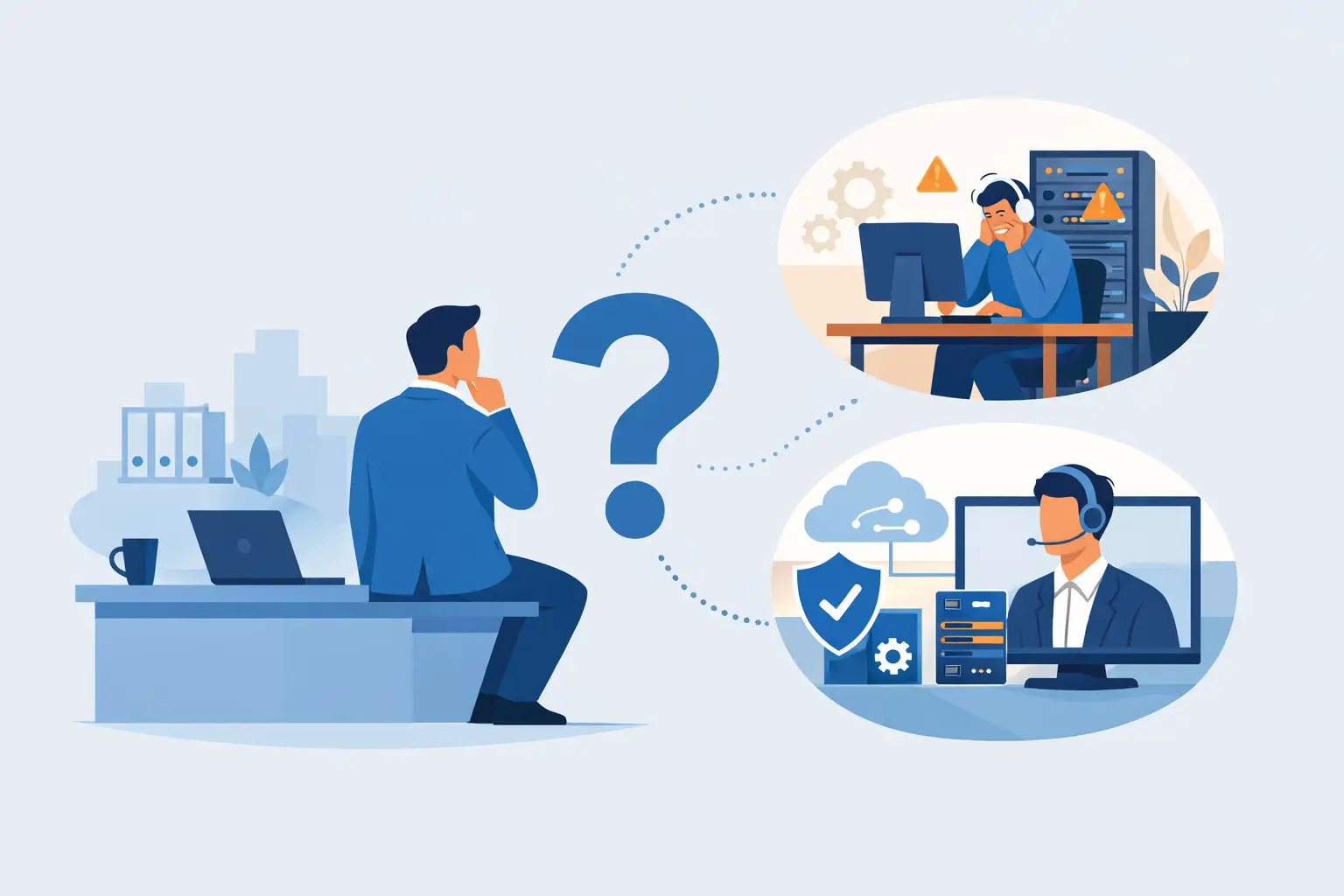
A printer issue that stalls invoices for half a day. A website form that stops working over the weekend. An employee laptop that fails right before payroll gets processed. For many owners and office managers, the question is not whether tech problems happen. It is when should a small business outsource IT so those problems stop draining time, revenue, and attention.
For most small businesses, the answer is not based on company size alone. It depends on how much your team relies on technology, how often problems interrupt operations, and whether your current setup gives you consistent support. If your business depends on computers, cloud apps, phones, internet access, cybersecurity, or a working website to serve customers, IT is already part of your daily operations. The issue is whether you are managing it in a way that makes business easier or harder.
When should a small business outsource IT? Start with the strain on your team
A common turning point is when internal staff are handling tech work they were never hired to manage. In many small companies, the office manager becomes the password reset person, the owner troubleshoots Wi-Fi, and the employee who is “good with computers” gets dragged into every issue. That arrangement may work for a while, but it usually creates hidden costs.
The first cost is time. When key employees spend hours fixing devices, contacting internet providers, updating plugins, or managing basic software issues, they are not doing the work that actually grows the business. The second cost is inconsistency. Internal tech help tends to be reactive and informal, so problems get patched instead of properly addressed.
If technology support has become a side job for people with other responsibilities, outsourcing starts to make practical sense. It gives your team room to focus on operations, sales, customer service, and delivery instead of acting as amateur IT support.
The clearest signs it is time to outsource
Some businesses wait until there is a major failure before getting help. Usually, the better move is to pay attention to smaller patterns that keep repeating.
If downtime is becoming normal, that is a strong indicator. Frequent login issues, slow computers, unstable networks, broken email configurations, or recurring software problems all point to an environment that needs active management. One issue by itself may not justify outside support. Ongoing disruption usually does.
Security is another major signal. Small businesses are often more exposed than they realize because updates get delayed, employees reuse passwords, backup systems are unclear, and no one is actively reviewing access or risk. If your business stores customer information, financial data, employee records, or operational files, weak IT oversight can become an expensive business problem very quickly.
Growth also changes the equation. Adding staff, opening another location, launching a new website, rolling out cloud tools, or introducing remote work all increase complexity. At a certain point, technology is no longer just a set of devices. It becomes the system your business runs on. That is often when outside support becomes more efficient than trying to coordinate everything internally.
Outsourcing is not only for break-fix support
Many owners hear “outsource IT” and think only about help desk tickets or hardware issues. In reality, outsourcing can cover much more than reactive support.
For a small business, IT often overlaps with website performance, software setup, workflow improvements, user access, digital tools, and the day-to-day reliability of customer-facing systems. If your website is outdated, your forms do not route properly, your team is juggling disconnected apps, or your internal processes rely on workarounds, those are business operations issues as much as IT issues.
That is why a broader support model can be valuable. Instead of working with one company for network issues, another for the website, and a freelancer for digital fixes, many businesses benefit from one accountable team that can handle the practical mix of support and execution. Set IT Solutions is built around that kind of model because many small and midsize businesses do not need a large internal department. They need responsive help that keeps both systems and digital assets working.
When keeping IT in-house still makes sense
Outsourcing is not automatically the right answer for every business at every stage. If your company has very simple technology needs, a tiny staff, few compliance demands, and minimal reliance on digital systems, full outsourced support may be more than you need right now.
It can also make sense to keep some functions in-house if you already have a capable internal person who manages day-to-day technology well and your business only needs outside help for specialized projects. Some companies do best with a hybrid model, where internal staff handle basic coordination while an outside partner provides deeper support, security oversight, website work, or project execution.
The goal is not to outsource for the sake of outsourcing. The goal is to make sure technology is managed at the level your business actually requires.
The cost question is usually bigger than the invoice
A lot of small businesses delay outsourced IT because they are focused on the monthly cost. That is understandable, but it can lead to a narrow decision.
The better question is what your current approach is already costing you. Lost employee time, repeated downtime, delayed customer responses, missed website leads, security exposure, and project slowdowns all carry real financial impact. Those costs just do not always show up on a single line item.
There is also a hiring reality to consider. Building even a modest internal IT function can be expensive for a small business. Salary, benefits, management time, training, and coverage gaps add up quickly. Outsourcing often gives businesses broader access to support and skills without taking on full staffing overhead.
That said, cheaper is not always better. If an outsourced provider is slow to respond, hard to reach, or limited to narrow technical tasks, the business may still end up managing too much internally. The real value comes from dependable support, clear communication, and services that match how your company operates.
How to tell if your business is ready right now
If you are trying to decide whether the timing is right, look at the last 90 days. Have tech issues interrupted work more than once? Has someone on your team spent significant time troubleshooting instead of doing their actual job? Are there unresolved concerns around security, backups, website maintenance, or employee onboarding? Are you adding tools or people without a clear system behind them?
If the answer to several of those questions is yes, your business is probably ready for outside help. You do not need to wait for a crisis. In fact, outsourcing tends to work best when it happens before systems become unstable or fragmented.
It is also worth looking at customer impact. If technology issues are affecting response time, service quality, scheduling, billing, communication, or lead conversion, the problem is no longer internal inconvenience. It is affecting revenue and reputation.
What a good outsourcing partner should actually provide
A small business should not feel like it is buying vague technical coverage. You should know what kind of help you are getting, how responsive the provider is, and where they fit into your operations.
A strong partner should help with immediate support needs while also reducing repeat problems over time. That means handling the basics well, but also noticing weak points in your setup, helping improve workflows, keeping systems updated, and supporting the tools your team actually uses. If your website, forms, internal tools, or digital customer touchpoints are part of daily business, those should not sit outside the conversation.
Just as important, the provider should communicate clearly. Small businesses do not need more complexity. They need practical recommendations, realistic timelines, and support that is easy to access when something breaks or needs attention.
The right time is usually earlier than most owners think
Many businesses outsource IT only after repeated frustration, a security scare, or a failed project. By then, the business has already absorbed months of inefficiency. A better approach is to recognize the point where technology stops being manageable as an informal task and starts needing steady oversight.
If your business depends on reliable devices, secure systems, a functioning website, digital workflows, and quick problem resolution, outsourced IT is not a luxury. It is operational support. And once technology becomes central to how you serve customers and keep work moving, waiting rarely makes things simpler.
The right time to outsource is usually the moment your team starts working around technology instead of benefiting from it. That is when outside support begins to pay for itself in fewer disruptions, better focus, and a business that runs with less friction every day.